
Textile Sourcing Archives - Square Corporation
textile mills in punjab square textile company square manufacturing company textile manufacturer

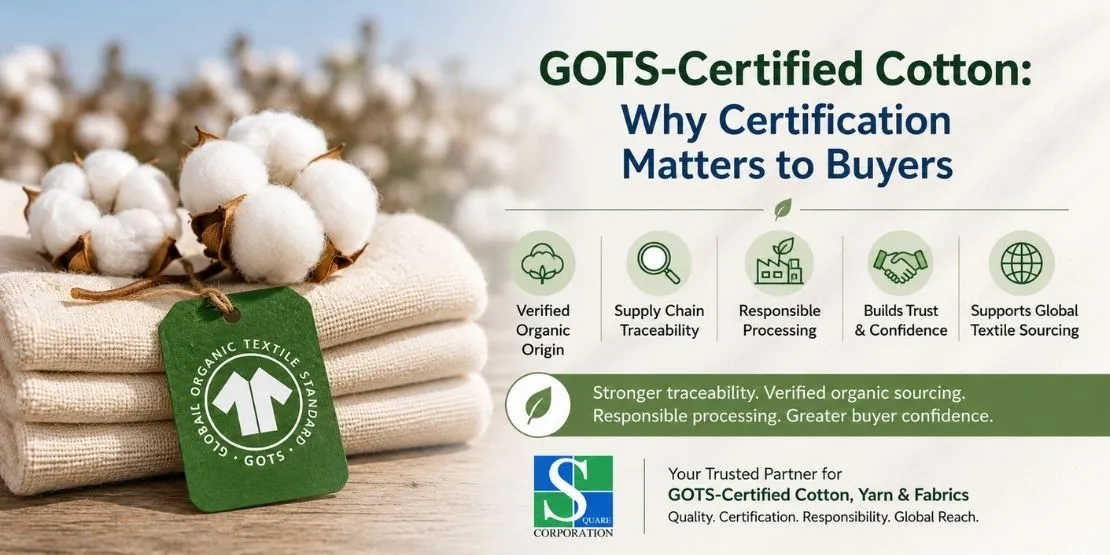
GOTS-Certified Cotton: Why Certification Matters to Buyers

A cotton product may look natural, feel soft, and carry an “organic” claim. However, what happens before it reaches the buyer matters as much. Today, textile buyers want more than attractive fibers and competitive prices. They want proof of responsible sourcing, reliable quality, and transparent production. For a textile exporter in Ludhiana, aligning with recognized sustainability standards can help meet these evolving buyer expectations.

This is where GOTS certification becomes significant. The Global Organic Textile Standard (GOTS) covers organic textile processing and supply chains through independent third-party certification. In this blog, we will highlight why GOTS-certified cotton matters to buyers and what makes it a dependable choice for modern textile sourcing.

Why GOTS Certification Matters to Cotton Buyers

Here are the reasons why GOTS certification matters to cotton buyers.

It Provides Verified Organic Origin

The first notable reason GOTS certification matters to cotton buyers is that it provides verified organic cotton. Simply calling cotton “organic” does not provide enough assurance about the complete textile supply chain. GOTS requires certified organic raw materials and sets requirements for their processing.

GOTS-certified products must consist of at least 70% certified organic fibers, with stricter requirements for products carrying the “organic” label grade. For buyers, this offers greater confidence when sourcing organic cotton for apparel, home textiles and other products.

It Supports Supply Chain Traceability

Do you know how important traceability has become in global textile sourcing? Nowadays, buyers need to know where materials come from and how they are processed. GOTS certification covers the supply chain from post-harvest handling through processing and trading. Independent certification bodies inspect certified operators, while Scope Certificates and Transaction Certificates provide additional documentation. This makes sourcing more transparent and helps buyers manage supply-chain risks.

It Promotes Responsible Processing

Another very prominent advantage of GOTS certification is that it promotes responsible processing. In recent times, GOTS is not limited to cotton farming. It also addresses environmental and social practices during textile processing. Its requirements cover areas such as chemical inputs, wastewater treatment, and worker-related standards. For businesses with sustainability goals, certified cotton can therefore support more responsible production.

It Builds Buyer and Customer Trust

In today’s competitive textile market, sustainability claims need credibility. Third-party certification gives buyers stronger evidence than an unsupported supplier claim. GOTS itself describes certification as a risk-management tool and an independent verification mechanism. This can help brands communicate their sustainability efforts with greater confidence.

It Supports Global Textile Sourcing

International buyers often look for suppliers that can meet recognized sustainability and compliance requirements. At Square Corporation, we work with certified organic cotton sourcing networks. We offer GOTS-certified organic cotton, along with yarn and fabric solutions for domestic and international markets. We work with more than 8,000 farmers across Maharashtra and focus on quality control, traceability, and responsible sourcing.

The Conclusion

To sum up, GOTS certification is not only about a sustainability label. For textile buyers, it can mean stronger traceability, verified organic sourcing, responsible processing, and greater confidence in the supply chain. As demand for sustainable textiles continues to grow, choosing the right certified supplier can make a meaningful difference.

Are you looking for GOTS-certified organic cotton, premium yarn, or sustainable fabric solutions from India? Then connect with Square Corporation. With our focus on quality, certification, responsible sourcing, and global textile supply, Square Corporation can help businesses build a more reliable, sustainability-focused sourcing strategy. So why wait? Contact Square Corporation, the best yarn merchant exporters in India, now.

Common Fabric Sourcing Mistakes That You Need to Avoid

Sourcing fabrics is highly instrumental to product development for both fashion designers and textile businesses. Fabrics are important in terms of aesthetics and quality. However, sourcing can be very complicated, with a number of suppliers to sort through and various technical specifications to consider. Far too many emerging brands make costly mistakes by failing to test fabrics properly, research the reliability of suppliers, or prioritize price over quality-all too often resulting in delay times and dissatisfied customers. The key to success is a strategic approach to wholesale fabric suppliers in India.

Mastering strategic fabric sourcing is an imperative strategy that can enable success in today’s competitive market. It provides the leeway to optimize production by avoiding common pitfalls, while maintaining consistency and enhancing a business’s relationship with its suppliers. Sourcing involves lining up quality, sustainability, and practicality for a brand’s vision, aside from finding the fabric. A thoughtful approach to fabric sourcing will make your products stand out positively.

Various Common Fabric Sourcing Mistakes You Should Be Aware Of

Selection of the right fabric forms the key to the success of any garment or textile item regarding aspects like comfort, quality, cost, and market value. Several common mistakes are made by start-up businesses in sourcing fabrics, leading to delays in production and financial losses. Avoidance of such mistakes would result in smoother operations, better quality control, and good relations with the suppliers.

Not defining the fabric requirements precisely

The critical thing here is to develop tight specifications so you get the right fabric for your product. Decide beforehand what the most important fabric properties are to you, including fiber type, grams per square meter weight, stretch, durability, colourfastness, and end-use, amongst other factors. Convey the exact specification so that mismatches and unsuitable fabrics are minimal in number; ensure only quality and great performance for your final product. Remember this fact when you plan on buying fabric from one of the best linen fabric manufacturers in India.

Price being the only aspect they are concerned with

Low-budget fabrics might look very attractive at first sight, but most of them compromise on durability, comfort, and even sustainability. You need to balance cost with quality for long-term performance. The best thing is to get fair pricing, not necessarily the lowest pricing. This way, you can reduce the chances of expensive returns and customer complaints due to low-quality material. A thoughtful choice gets a better result on every front.

Ignoring lead times and delays in supply chains

Long lead times can be disruptive, whether in production or product launches. Check out your suppliers before you place an order. See how quickly they ship, how much you can actually count on them, and what their delivery times look like in real life, not just on paper. Build in some extra time for yourself so you’re not scrambling at the last second. This way, you get your goods on time and avoid unnecessary stress.

Ignoring shrinkage-related fabric-care specifications

Certain fabrics may shrink, stretch, or change texture after a wash. The changes in fabric will affect the fit as well as the appearance of the garment. Care properties such as wash, iron, and dry must be thoroughly tested so any adaptations can be made in your pattern or production in order to maintain the shape, size, and finish of fabrics even in consumer use.

Overlooking fabric availability and consistency

Note that some fabrics may be discontinued, or there may be a difference from one production batch to another. You do need to discuss long-term availability and batch-to-batch consistency with your suppliers. Where possible, negotiate a contract or reservation of fabric for future runs, so you can ensure product consistency and minimize resourcing challenges considerably.

Conclusion

When you’re sourcing fabric, it’s just as important to know what mistakes to avoid as it is to find the right materials. Start by getting clear on exactly what you need. Test the fabrics, check out your suppliers, and keep sustainability in mind. That’s how you make choices that really save time, money, and hassle. Good sourcing isn’t just about picking fabric off a shelf. It’s about working with people you trust, making sure the quality stays solid, and choosing materials that actually fit your brand’s vision and values.