
November 2026 - Square Corporation
textile mills in punjab square textile company square manufacturing company textile manufacturer

The Role of Responsible Manufacturing in Building a Low-Waste Textile Industry

Each yard of fabric produced in a textile factory has its own unique story, but in most cases, that story ends at a dumpsite. Environmental manufacturing arises when the creation of waste is regarded as a design challenge and can therefore be overcome through improved manufacturing techniques. Each step in the manufacturing process offers an opportunity for reduction of waste. Organic cotton manufacturers in India have shown that environmental manufacturing and commercial success can co-exist.

Responsible manufacturing spans the whole supply chain. Precise cutting will save on waste, but the scrap collection process will ensure that scraps get used to make recycled materials. Water and dye recovery systems minimize the need for chemicals, but energy-efficient machinery cuts down on emissions. Waste reduction is built into the design process. The overall process may be costly in planning and investment, but it leads to a more efficient textile industry.

Various Roles of Responsible Manufacturing in Building a Low-Waste Textile Industry

Proper manufacturing can be helpful in saving textiles and preserving natural resources. It can be helpful to ensure ethical manufacturing practices. The textile industry can make quality products through proper decisions.

Choose sustainable raw materials for textile production

Textile production requires the right choice of materials. The use of organic or recycled materials would help limit the impact of this industry on nature. Some examples of raw materials used are organic cotton, recycled polyester, linen, and hemp.

Work with responsible textile suppliers

A low-waste textile industry is not dependent on factories alone but also on those who provide the raw materials used. Manufacturers can benefit from working with responsible textile suppliers in India to get quality materials. Choose suppliers who provide full information about their products and follow safe manufacturing practices.

Use water-efficient methods

Water has an important part to play in the process of making textiles. Water is needed for washing, dyeing, printing, and finishing the fabric. Traditional methods may consume plenty of water, which may be difficult for local water sources. The right manufacturer may install water-efficient machinery and recycle water whenever possible.

Improve energy efficiency in textile factories

Energy is consumed in textile factories for machinery, heating, lighting, drying, and other processes involved in manufacturing. High energy consumption develops to high operational costs and pollution. Energy efficiency can be increased through the use of modern machinery, energy-efficient lighting such as LEDs, and efficient heating methods.

Reduce packaging waste

The third source of waste in textiles could be the packaging of goods. Often, the plastic film, excessive packaging, and other non-reusable items end up in garbage. Companies could use recyclable cardboard packaging or reusable packaging, as well as use less packaging that is required for particular products.

Train workers in responsible manufacturing practices

The employees also contribute significantly to the reduction of waste in textiles. The most sophisticated equipment will not help much if the people using it are not trained. They need to know how to manage the material, machine, waste, water, and energy.

Track waste and set clear sustainability goals

You cannot improve something if you do not know how to measure it. Textile producers should monitor the amount of cloth, water, energy, and packaging used in the production process. This data allows one to see where wastage is the greatest. For example, one company may waste a lot of fabric in the cutting process.

Conclusion

Responsible manufacturing is one key aspect that will help create a zero-waste fashion industry. Apart from using eco-friendly fabrics, responsible manufacturing involves reducing the amount of water used, conserving energy, recycling waste, producing quality products, and ensuring fair treatment for laborers. Each stakeholder in the whole chain of operation has a significant role to play in ensuring that the production process of textile products is sustainable.
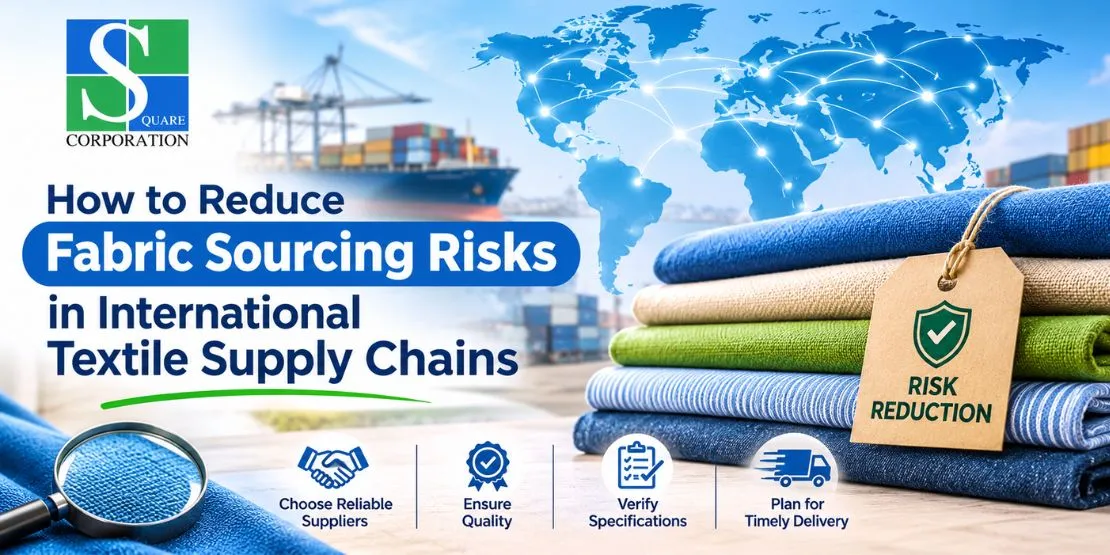
How to Reduce Fabric Sourcing Risks in International Textile Supply Chains

Garment manufacturing success often starts long before the first piece of fabric reaches the cutting table. It starts with the right fabric sourcing decision. For international fashion brands, garment manufacturers, and textile businesses, sourcing the right sustainable fabric supplier in India is about more than comparing prices or browsing product catalogues.

Every fabric sourcing decision matters for maintaining garment quality, fulfilling the production cycle, managing the production process, and delivering products on time to fulfil customer expectations. However, international textile supply chains often don’t move predictably, with sudden raw-material shortages, inconsistent fabric quality, or shipment delays.

If a clothing manufacturer discovers variations in fabric weight or colour, it can disrupt the manufacturing process. Thus, reducing fabric sourcing risks is vital for the international textile supply chain.

Now let’s explore this blog to ascertain how to reduce fabric sourcing risks in the international textile supply chain.

How to Reduce Fabric Sourcing Risks in the International Textile Supply Chain

In this section, we will discuss how to reduce fabric sourcing risks in the international textile supply chain.

1. Assess risk before choosing a fabric supplier

Fabric suppliers often offer attractive prices that may not reflect their production capabilities. Quality consistency and delivery arrangements are two vital aspects to maintain for a particular order.

Textile manufacturers mainly need to ascertain differences in GSM, colour, texture, shrinkage, and fabric construction between the approved samples and the bulk order. In addition, limited availability of cotton, organic fibre, or specialized yarn can affect the production schedule.

However, trusted and reliable fabric suppliers understand the importance of global textile sourcing and the fabric supply process.

2. Evaluate the fabric suppliers beyond the quoted prices

Price is naturally an important consideration when sourcing fabric in bulk. A slightly cheaper fabric may require more inspection, produce higher cutting waste or fail to meet the performance expectations of the finished garment. That’s why, before finalising a supplier, businesses need to evaluate industry experience and export capabilities, available fabric categories, production capacity, quality assurance practices, and order coordination.

For international buyers, working with an experienced textile exporter in India can provide valuable access to diverse fabric options, established industry networks, and sourcing expertise.

3. Never overlook pre-production fabric testing

A fabric may look perfect in the supplier catalogue, but its actual function differs when it passes through various testing stages. For textile manufacturers, it is a great challenge to produce large quantities of clothing, where small variations can affect the overall reputation.

Emphasise quality control across textile buyers’ demands, helping international textile buyers focus on fabric quality and consistency when sourcing from the biggest textile exporter in India.

4. Maintain clear fabric specifications and documentation

Sometimes fabric sourcing problems do not arise because a supplier lacks expertise. It happens because buyers and suppliers interpret the same requirement in a different way. For example, a manufacturer may request cotton-blend knitted fabric without specifying the exact fibre composition, GSM, and colour tolerance.

The supplier may deliver a technically acceptable fabric that still does not meet the manufacturer’s expectations. That’s why international buyers need to request technical fabric documentation before placing a bulk order.

Conclusion

Maintaining a smooth supply of fabric and fulfilling buyers’ expectations must be the primary goal of international textile buyers. If you are searching for a reliable fabric sourcing partner, you can trust Square Corporation. We understand that every fabric requirement comes with its own expectations, and we maintain product quality, timely delivery, and proper materials.

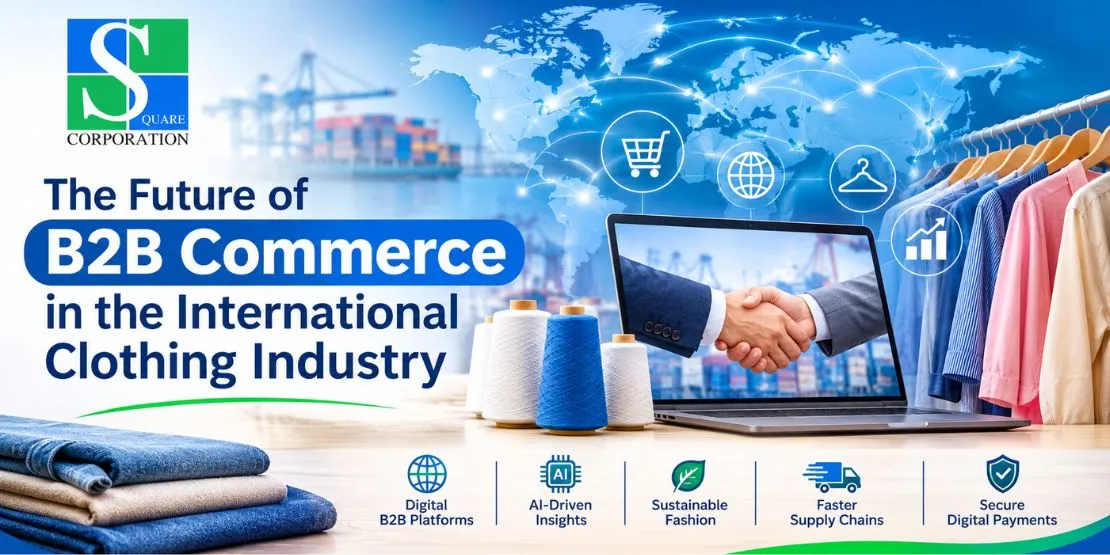
The Future of B2B Commerce in the International Clothing Industry

The business of clothing internationally is evolving from an old-fashioned approach into a digital age. Whereas transactions used to drag their feet using faxes and trade exhibitions, they now occur at the click of a button. It is a new way of doing business for the brands, mills, and suppliers involved. Cotton yarn exporters become central to this evolution because they act as the connecting factor between the supply side and the demand side on an international level.

Tomorrow’s B2B fashion industry: digital, transparency, and data-driven decision-making. Digital platforms allow the comparison and testing of products as well as their purchase without traveling across oceans, and intelligent tracking makes sure that everything is properly tracked. Smaller companies gain access to global supply chains that were accessible exclusively to big companies before. The successful ones will be the speedy and reliable ones.

Future of B2B Commerce in The International Clothing Sector

B2B E-Commerce is revolutionizing the global garment industry through technological and logistical innovations. Learn about the new developments that are making this happen.

Digital B2B platforms are changing global clothing trade

It is much easier to buy and sell clothes across different countries. This is because of the use of digital B2B sites where buyers can meet manufacturers and place their orders. The digital B2B sites can be regarded as big business-to-business marketplaces online.

Artificial Intelligence is making business decisions smarter

The use of AI is proving to be very helpful in the clothing business. It assists organizations in analyzing customer demands and predicting popular items, as well as in stock management. For instance, an exporting organization may use its sales information to determine the type of fabric or dress that will be in demand during the following season.

Social media will support b2b clothing marketing

Apart from being used to approach individuals as consumers, social media is increasingly becoming an essential means of marketing to other businesses as well. LinkedIn, Instagram, and Facebook platforms allow clothing companies to showcase their products to possible buyers. Well-crafted posts can introduce new fabric collections, share factory updates, or showcase recent work. Textile exporters in India can benefit greatly from using these social media platforms for branding.

Faster supply chains will improve order delivery

In clothing exports and imports, the timing of delivery is very important. Late delivery could spoil the whole season for the seller. This is why companies are searching for fast and dependable supply chains. Better stock management, better transport systems, and order tracking through the Internet could help. The buyer will know the location of their orders.

Customized clothing orders will gain more attention

All international buyers are not after the same merchandise. While some may need customized clothing items, others may have specific demands about fabrics, sizing, coloring, or design. B2B commerce has made this task easier. Buyers can communicate their needs online and talk about the product before purchasing.

Digital payments will make international trade easier

Cross-border payments have been a problem area for clothing companies. Different currencies, transaction fees, and time lags in the payment process may pose issues in transactions. The use of digital payment systems is proving helpful for businesses in handling these issues.

Conclusion

For B2B businesses in the international clothing business in the future, there are some key issues that need to be considered. Technology, sustainability, fast delivery, and a great experience for customers are among them. It is not enough for buyers to have only cheap products.