

Bulk Order Suppliers
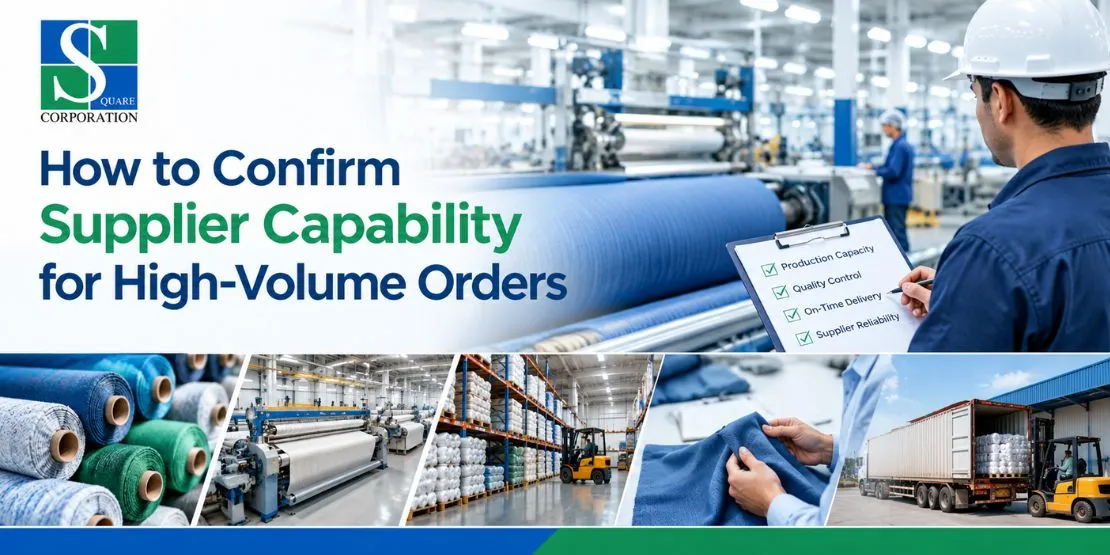
How to Confirm a Supplier’s Capability for High-Volume Orders
05 September 2026 | By admin
Large orders may seem great on paper; however, things get serious once a supplier needs to supply thousands of pieces without sacrificing quality and deadlines. Irrespective of whether you are assessing a Ludhiana fabric supplier or any other manufacturing partner, it is crucial to ensure that the manufacturer has the capability, labor force, material, quality control mechanisms, lead time, and experience with large orders prior to making a deal.
In case the selected vendor is capable of meeting big orders, one should make sure the company can scale up to match requirements. One should begin with the company’s performance in the past, with production data and sample products from previous batches. Check the abilities of their machinery and workers, and discuss quality control measures and delivery schedules. In this article, we will give you a list of how to check supplier capability.
Various Ways to Confirm a Supplier’s Capability for High Volume Orders
A large order not only entails favorable prices but also calls for the buyer to ascertain whether the supplier is capable of producing the required number of items.
Verify actual production capacity
You should begin by asking the supplier what quantity they will be able to manufacture in the time period you require. You should not limit yourself to the maximum capacity that the supplier claims to have; you should look at current manufacturing loads, machines, workforce, working shifts, and capacity utilization.
Check financial and operational stability
Big orders may create a strain on the finances, procurement of raw materials, labor, and production of the supplier firm. Think about whether the company seems to be financially sound to handle the order from the start until completion. In the case where the suppliers are textile exporters in India, the buyers have to assess the financial soundness, production capacity, export expertise, and reliability of delivery.
Inspect the factory and production facilities
In any case, make sure you visit the facility or perform an audit independently. Look at the assembly lines, machinery, storage, raw material facilities, quality control, and labor organization. Physical inspection will provide assurance that the facilities match what was told about them during the negotiation process.
Evaluate quality-control procedures
When there is high-volume production, there is a higher chance of inconsistencies when the quality control process is not robust. Inquire from the supplier regarding how their materials, production batches, products, packages, and deliveries are being inspected. It is best if the quality standards are set prior to production, and proper inspection is done.
Analyze lead times and delivery performance
Inquire from the supplier about their average production lead time and ascertain if they can achieve this lead time based on your deadline and quantity requirements. Check the supplier’s past records for on-time deliveries. It is important to consider this procurement measure since late deliveries can have an effect on inventory and customer commitments.
Create a supplier performance scorecard
Use measurable criteria to make the final call instead of just considering the cost. Rank the potential suppliers on their capacity for production, quality, lead times, reliability of delivery, communication, certifications, financial stability, cost, and scalability. Establishing these criteria prior to placing the order will ensure objectivity when comparing different suppliers and will also give you something tangible with which to measure the supplier’s performance post-production.
Conclusion
The confirmation of a supplier’s ability to deliver before giving an order that is likely to be large helps avoid delays and poor quality. The confirmation includes the capacity of production, control of quality, performance, availability of raw materials, financial stability, and scalability.
 Previous Post


Recent Posts

How to Reduce Fabric Wastage in Cotton Garment...
Fabric Sourcing: Quality & Consistency for Jeans Manufacturers
Why Pre-Shipment Inspections Are Vital for Quality Assurance...
Organic Fabric for Babywear: What Textile Manufacturers Should...